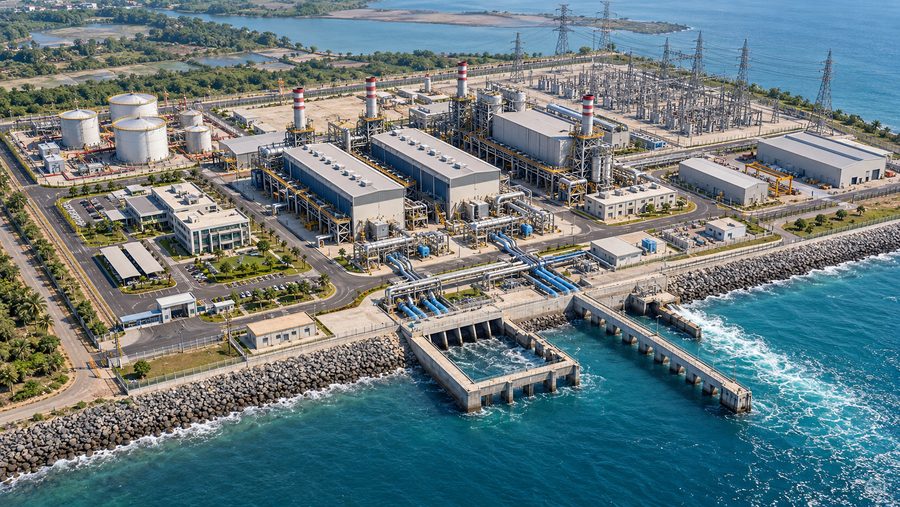
01 · FUEL
Storage and treatment
Heavy fuel oil is held in bunded tanks, cleaned by centrifugal separators and heated until it reaches injection viscosity.
2 storage tanks · 3 separators · heated to ~130 °C
DELTA-100 turns two recovered MAN B&W two-stroke marine engines into a coastal heavy-fuel-oil power station, with waste-heat recovery and seawater cooling.
Large merchant ships run on two-stroke diesel engines designed for decades of continuous duty. When a ship ends its service, its engine often has years of life left. DELTA-100 buys two of these engines at scrap-weight prices, refurbishes them and puts them to work on land.
The technology is not new to Bangladesh. Diesel-engine HFO plants with exhaust heat recovery already supply BPDB, including Baraka Patenga in Chattogram. What differs is how the machinery is procured. Instead of new generating sets, DELTA-100 starts from engines that already exist.
Can DELTA-100 deliver one megawatt of dependable, contracted electricity for less than half of Baraka Patenga's historical capital cost per megawatt?
Refurbishment, generator integration and certification of recovered propulsion engines are not yet costed. The saving holds only after those are included.
The plant follows the same order a marine engineer knows from the engine room, rearranged for continuous power generation on land.
Heavy fuel oil is held in bunded tanks, cleaned by centrifugal separators and heated until it reaches injection viscosity.
2 storage tanks · 3 separators · heated to ~130 °C
Two recovered MAN B&W engines turn at about 94 rpm and drive their generators directly, with no gearbox.
2 × 40 MW shaft · ~170 g/kWh near full load
Exhaust leaves the turbochargers at 215–260 °C. Boilers recover that heat as steam. An oil-fired auxiliary boiler can add steam when needed.
~9 MW of heat recovered per engine at full load
Recovered steam drives a condensing turbine. Every megawatt here is produced without burning extra fuel in the engines.
~3.5 MW from exhaust heat alone (modelled)
Seawater from the Bay of Bengal cools the engines and condenses turbine steam, then returns to the sea within the discharge temperature limit.
4 pumps × 2,500 m³/h · ~56 MW of heat rejected
Generator output is stepped up and exported to the national grid through the plant switchyard, after supplying the station's own loads.
11 kV generation · 132/230 kV export (to be confirmed)All images are AI-generated concept visualizations, not photographs of existing equipment. Ratings are engineering assumptions used in the simulator.
The working estimate is 10 acres (1,000 decimals), with 8 acres as a compact layout and 12 for more flexibility. The final footprint depends on how the recovered engines are installed and how the cooling-water line is routed.
| Facility | Acres |
|---|---|
| Total | 10.0 |
Comparable plants: Baraka Patenga, 50 MW on about 3 acres; Meghnaghat HFO, 100 MW on about 8 acres; Energypac Thakurgaon, 115 MW on about 9 acres.
A narrated walkthrough from the coastal approach to grid connection. The visuals are conceptual, and the 100 MW output is marked unverified throughout.
Modelled on the engine room simulators that marine engineers train on. Every system is live: load the engines, trip a pump, foul a cooler, and see which part of the plant limits output.
The model follows the usual Bangladesh IPP structure: BPDB pays a capacity charge for available megawatts, passes fuel cost through per kWh, and pays a variable O&M charge. Every input below is adjustable. Defaults are stated assumptions, not agreed terms.
Baraka Patenga Power is a 50 MW HFO station in Chattogram using the same engine-plus-steam-turbine configuration. Its figures come from the company's prospectus, its environmental assessment and Rolls-Royce's 2011 contract announcement.
| Parameter | Baraka Patenga | DELTA-100 |
|---|---|---|
| Engine procurement | 8 new Rolls-Royce Bergen B32:40 sets | 2 recovered MAN B&W two-stroke engines |
| Engine capacity | 55.87 MW | 80 MW shaft |
| Waste-heat steam turbine | 3.2 MW | ~3.5 MW modelled, design pending |
| Contracted capacity | 50 MW | 100 MW target · 77.8 MW modelled |
| Project investment | ৳415 Cr (historical) | ৳350 Cr proposed |
| Capital per MW | ৳8.30 Cr | ৳3.50 Cr at target · ৳4.50 Cr modelled |
| Fuel | HFO | HFO |
| PPA | 15 years from May 2014 | To be negotiated |
Baraka's investment is a historical company-reported figure and is not inflation-adjusted. Its engine contract covered complete new generating sets, while DELTA-100's engines still need overhaul, generator integration and certification, so the comparison is not yet like-for-like.